

Inside ZAMZILLA: How an AI Ecosystem Is Connecting Businesses With Industry-Specific Intelligence
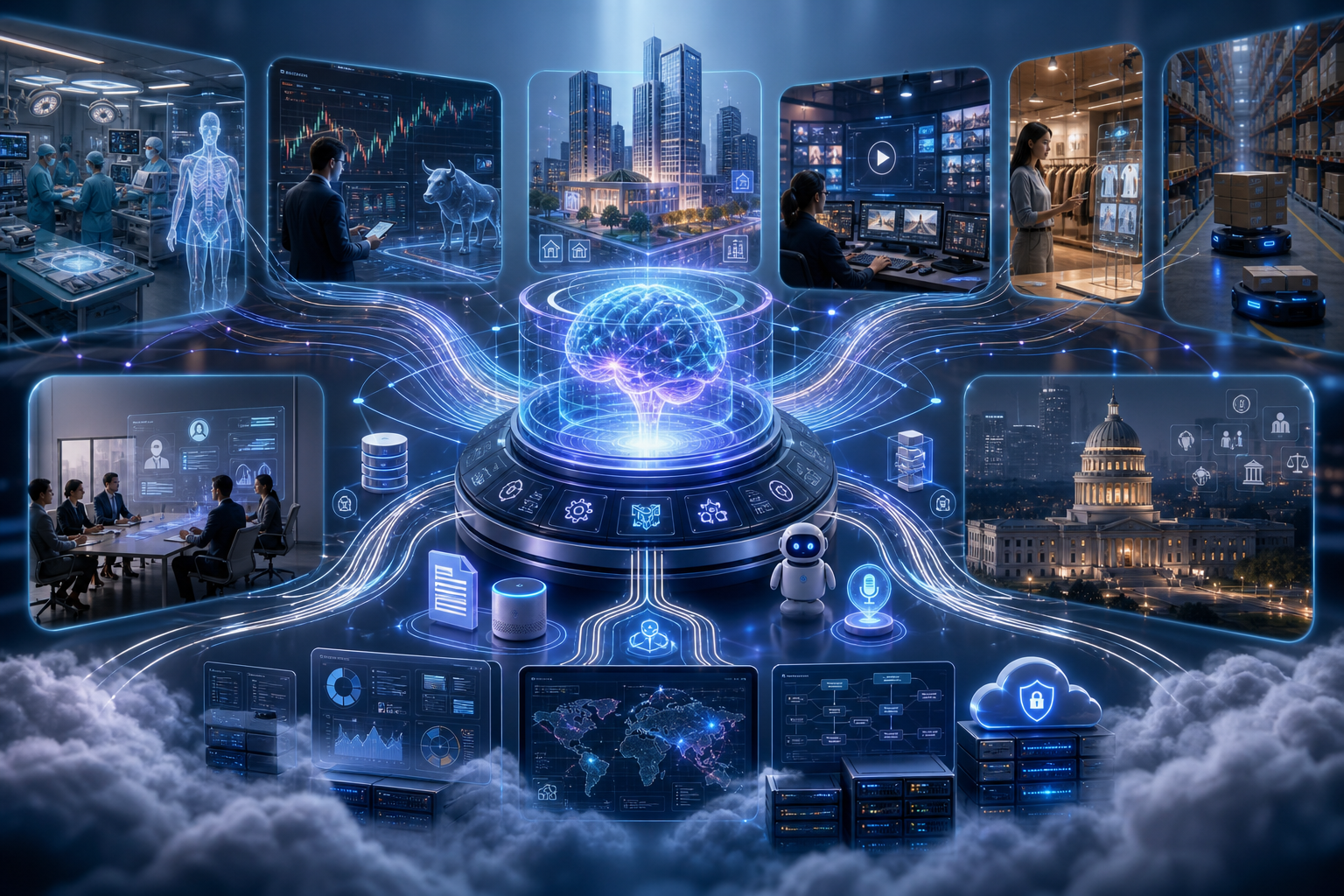
ZAMZILLA presents an AI ecosystem focused on industry-specific solutions rather than general-purpose assistants. Its platform organizes more than 300 business solutions and 80 specialized AI engines across sectors including healthcare, finance, real estate, media, HR, commerce, supply chain, and public services.
The ecosystem combines domain knowledge retrieval, autonomous applications, agentic workflows, voice and telephony tools, enterprise integrations, and support for public, private, hybrid, multi-cloud, and edge-cloud environments. Its stated aim is to connect AI models with organizational data, existing systems, and operational processes.
Artificial intelligence is becoming increasingly specialized.
The first wave of business AI focused heavily on general-purpose assistants, chatbots, content generation, and individual productivity tools. The next phase is moving toward systems that understand particular industries, connect with operational workflows, and help organizations solve problems specific to the way they work.
ZAMZILLA is building its platform around this broader vision of industry-specific intelligence.

Rather than treating AI as a single product, ZAMZILLA presents an ecosystem designed to connect businesses with specialized AI solutions, autonomous systems, cloud infrastructure, and technology built for different industry environments.

Why Generic AI Is Not Always Enough
A general AI model can be powerful, but businesses operate within specific contexts.
A healthcare organization works with different information and processes than a real estate company. A financial organization has different requirements from a retailer. A media company may need completely different technology from a manufacturer.
The value of enterprise AI therefore depends not only on the underlying model but also on how that intelligence is adapted to the business environment.
ZAMZILLA’s current ecosystem organizes its solutions around multiple industry verticals and specialized business needs. The platform lists areas including healthcare, real estate, finance, media, voice, HR, commerce and supply chain, and public-sector environments.
A Marketplace of Business-Focused AI
One of the most notable elements of the ZAMZILLA model is its breadth.
The platform currently describes an ecosystem containing more than 300 business solutions and 80 specialized AI engines. Rather than asking organizations to begin with one generic tool, it allows businesses to explore solutions according to their industry and operational requirements.
This creates a different way of thinking about AI adoption.
Instead of asking which single AI application a company should purchase, organizations can begin by identifying a business challenge and then exploring the technology required to address it.
That distinction can be important as companies move from experimentation to practical implementation.
From AI Models to AI Applications
Modern businesses often use several layers of technology.
At the foundation are AI models. Above them are applications, workflows, databases, integrations, user interfaces, and business processes.
The real business value appears when these layers work together.
ZAMZILLA describes a multi-model approach involving major AI technologies and presents an ecosystem that combines AI engines with specialized business applications. Its platform also highlights capabilities such as autonomous micro-app generation and domain knowledge retrieval.
This approach moves the discussion beyond the question of which AI model is most powerful.
For many businesses, the more practical question is how AI can be connected to the systems, knowledge, and workflows already operating inside the organization.
Turning Business Knowledge Into Usable Intelligence
Every organization has valuable knowledge.
It can exist inside websites, product catalogs, documents, customer records, policies, databases, contracts, and internal systems.
The challenge is making that information available at the right moment.
ZAMZILLA’s platform describes domain knowledge crawling and retrieval capabilities designed to connect enterprise information with AI-powered interactions. This type of architecture can help organizations move toward systems that work with their own information instead of relying only on general-purpose knowledge.
That is an important direction for enterprise AI because useful intelligence often depends on context.
The Role of Automation
Intelligence becomes more valuable when it can lead to action.
A system that identifies a customer request is useful. A system that can understand the request, retrieve relevant information, update the appropriate business system, schedule a follow-up, and keep the workflow moving can become part of the operational process itself.
This is where automation and agentic AI meet.
ZAMZILLA’s ecosystem emphasizes autonomous systems and agentic workflows, including voice, telephony, business applications, and integrations with existing enterprise environments.
The objective is not simply to make AI more conversational. It is to make business processes more connected and capable.
Built for Different Deployment Environments
Enterprise organizations do not all use the same infrastructure.
Some rely heavily on public cloud services. Others require private or hybrid environments because of operational, regulatory, security, or data-management requirements.
ZAMZILLA’s company information describes support for public, private, hybrid, multi-cloud, and edge-cloud environments.
This flexibility matters because AI adoption is closely connected to infrastructure decisions. Businesses need to consider where their data lives, how systems communicate, who can access information, and how new AI capabilities fit into existing technology environments.
A Broader Vision for Business AI
The development of AI is increasingly moving from individual applications toward ecosystems.
Businesses want tools that work together rather than another disconnected application. They want AI that understands their industry rather than generic answers. They want automation that can interact with real workflows rather than simply generate recommendations.
That is the space ZAMZILLA is attempting to address.
The company’s official platform presents a broad ecosystem of AI solutions, specialized engines, industry verticals, autonomous technologies, and enterprise infrastructure. Businesses interested in exploring the ecosystem can visit the official “ZAMZILLA platform” (https://zamzilla.com/) to review its available solutions and technology offerings.
Conclusion
The next generation of business AI will not be defined only by smarter models.
It will also be defined by how effectively those models can understand industry context, access organizational knowledge, connect with existing systems, and participate in real business workflows.
ZAMZILLA is building around this broader concept by bringing industry-focused AI solutions, specialized engines, automation, applications, and infrastructure into a connected ecosystem.
As businesses continue moving from AI experimentation toward practical deployment, ecosystems built around specialized intelligence and connected workflows will become an increasingly important part of the technology conversation.