
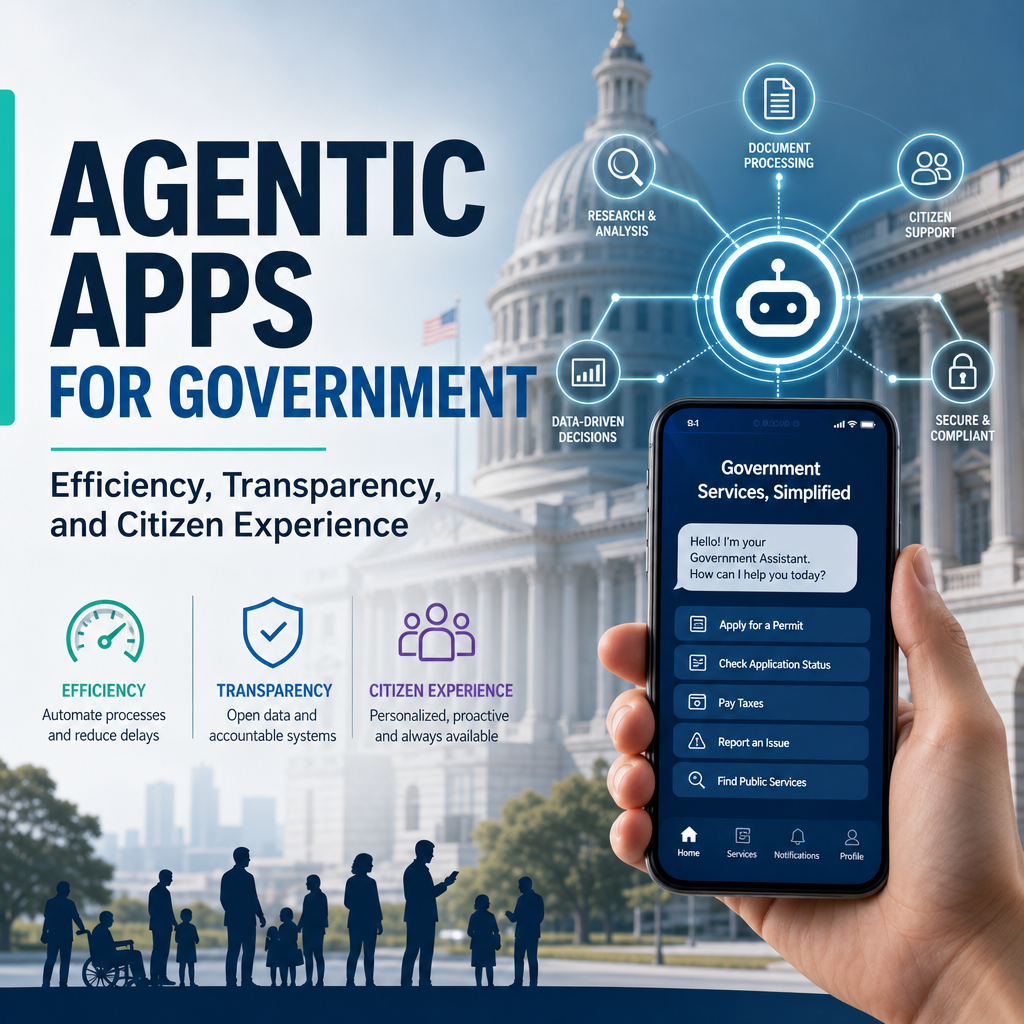
Agentic Apps for Government: Efficiency, Transparency, and Citizen Experience
Agentic Apps for Government & Public Services: Efficiency, Transparency, and Citizen Experience
Government and public services are under growing pressure to do more with less. Citizens expect faster responses, simpler processes, and more transparent services, while agencies must manage limited budgets, complex regulations, and rising demand. In this environment, agentic apps are emerging as a powerful way to modernize how public institutions operate.
Unlike traditional software that only follows fixed rules, agentic apps can take initiative, coordinate tasks, and adapt to changing situations. For government and public services, that means better efficiency, improved transparency, and a more responsive citizen experience.
What Are Agentic Apps?
Agentic apps are software systems that can act toward a goal with a degree of autonomy. They do not just wait for users to click through every step. Instead, they can:

- interpret requests
- gather information from multiple systems
- recommend or execute next actions
- track progress across workflows
- adjust based on new inputs or constraints
In a public sector setting, this can be especially useful because many services depend on multiple departments, forms, approvals, and data sources. An agentic app can help connect those moving parts and reduce friction.

Why Government Needs a New Approach
Many public service processes are still built around manual handoffs and fragmented systems. A simple request may involve repeated data entry, long wait times, and unclear status updates. For citizens, this often feels frustrating and opaque. For staff, it creates extra workload and increases the risk of error.
Agentic apps can help address these pain points by supporting more coordinated and intelligent service delivery. They can assist caseworkers, automate routine steps, and make services easier to navigate for both employees and the public.
Improving Efficiency Across Public Services
Efficiency is one of the clearest benefits of agentic apps. Government agencies often handle high volumes of predictable tasks, such as benefits processing, permit approvals, appointment scheduling, and records retrieval. These workflows are ideal for intelligent automation.
Faster Case Handling
An agentic app can triage incoming requests, identify missing information, and route cases to the right department. It can also prioritize urgent matters, reducing delays for citizens who need help quickly.
Less Administrative Burden
Staff spend a significant amount of time on repetitive work like data entry, document checks, and follow-up notifications. By automating these tasks, agentic apps free employees to focus on higher-value work that requires human judgment, empathy, and oversight.
Better Use of Resources
Public agencies often face budget constraints. Agentic apps can help allocate staff time more effectively, reduce manual rework, and lower the cost of service delivery. Over time, these gains can add up to meaningful operational savings.
Increasing Transparency and Accountability
Transparency is essential in government. Citizens want to know how decisions are made, where their request stands, and what to expect next. Agentic apps can improve visibility into public service workflows by making status and actions more traceable.
Clearer Process Tracking
When a citizen submits a request, an agentic app can provide real-time updates on each step of the process. This reduces uncertainty and lowers the need for repeated calls or emails asking for status updates.
Better Audit Trails
Because agentic apps can log actions and decisions automatically, they make it easier to review how a case was handled. This is valuable for compliance, oversight, and internal quality control.
Consistent Decision Support
In many public services, consistency matters as much as speed. Agentic apps can help apply policy rules more uniformly and flag exceptions for human review. This creates a stronger foundation for fair and explainable outcomes.
Enhancing the Citizen Experience
A better citizen experience is one of the most important outcomes of digital transformation. People do not want to understand government structure; they want their issue resolved quickly and clearly. Agentic apps can make public services feel more accessible and less bureaucratic.
Simple, Guided Interactions
Instead of asking citizens to figure out complex forms or navigate multiple portals, agentic apps can guide them through the process step by step. They can ask only for the information needed, in plain language, and help users complete tasks with less effort.
Personalized Support
Different people have different needs. A resident applying for housing support may need a different path than someone renewing a license. Agentic apps can adapt the experience based on the user’s situation, making services more relevant and useful.
Multichannel Access
Citizens expect services across web, mobile, chat, and even voice. Agentic apps can support a more seamless experience across channels, helping people start a process in one place and continue it in another without losing context.
Key Considerations for Public Sector Adoption
While the promise is strong, government agencies should approach agentic apps carefully. Public trust depends on responsible design and deployment.
Important considerations include:
- Privacy and security: Sensitive citizen data must be protected at every step.
- Human oversight: High-stakes decisions should still involve people.
- Explainability: Agencies should be able to explain how actions were taken.
- Equity: Systems should be tested for bias and access barriers.
- Integration: New tools must work with existing systems and workflows.
A thoughtful implementation strategy is essential. The goal is not to replace public servants, but to equip them with better tools.
The Future of Public Service Delivery
As governments continue to modernize, agentic apps are likely to play a central role in digital service delivery. They offer a practical way to improve efficiency, strengthen transparency, and create more responsive citizen experiences.
The most successful public agencies will be those that combine automation with human judgment, ensuring that technology serves the public interest. With the right safeguards and design principles, agentic apps can help build public services that are faster, fairer, and easier to use.