
Why Every Industry Needs Its Own AI Platform: ZAMZILLA’s 200+ Builds
Why Every Industry Needs Its Own AI Platform — And How ZAMZILLA Built 200+ of Them
Artificial intelligence is no longer a single, universal tool that can solve every business problem in the same way. What works for retail may fail in healthcare. What helps a logistics company may not fit a legal firm. As AI moves from experimentation to real-world adoption, one thing is becoming clear: every industry needs its own AI platform.
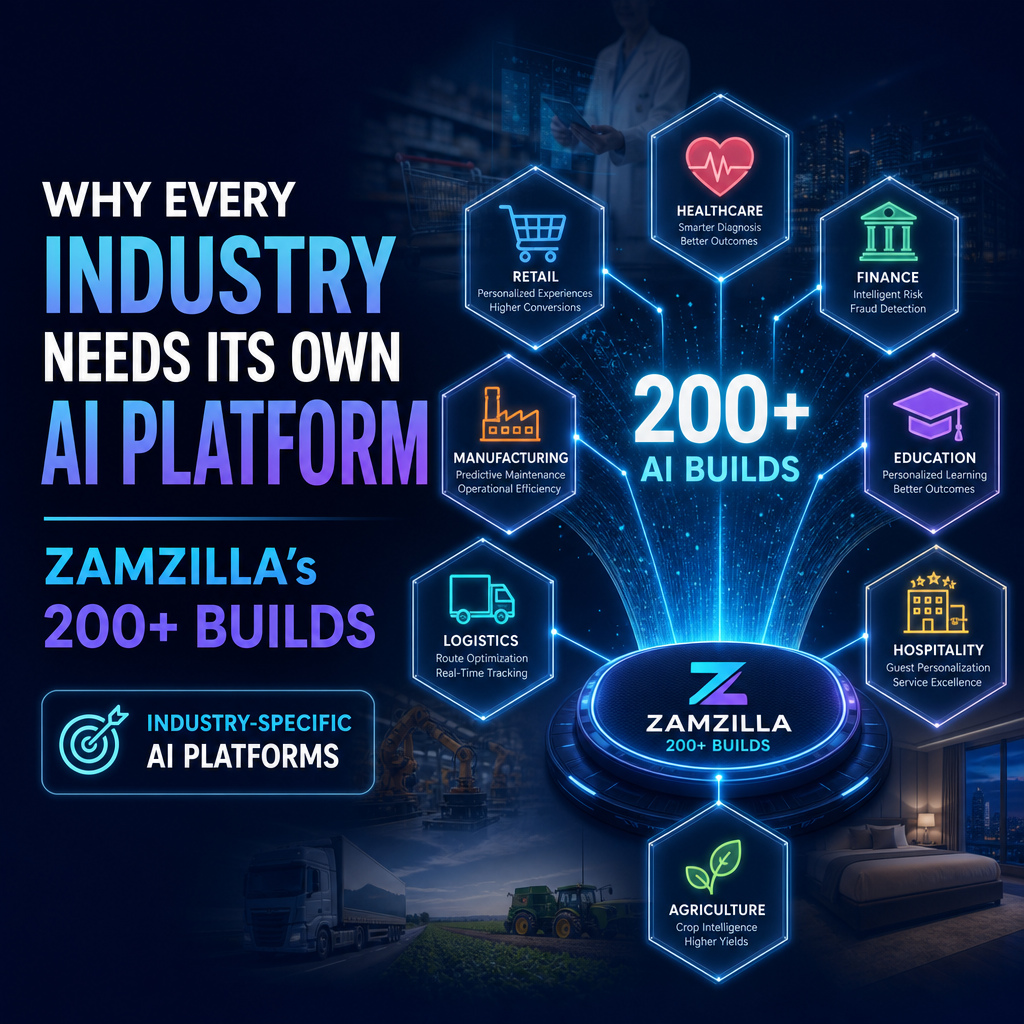
That is the idea behind the rise of industry-specific AI. Instead of forcing one generic system to serve everyone, businesses are now building platforms tailored to the data, workflows, compliance rules, and goals of a specific sector. ZAMZILLA is one company that has taken this approach seriously, building more than 200 AI platforms designed for different industries.
Why generic AI is not enough
Off-the-shelf AI tools can be useful for simple tasks. They can summarize text, answer common questions, or automate basic workflows. But industries are rarely simple.

Each sector has its own:

- language and terminology
- regulations and compliance requirements
- data formats and systems
- customer expectations
- operational bottlenecks
A hospital, for example, needs AI that understands patient data privacy and medical documentation. A manufacturer needs AI that can monitor equipment, forecast failures, and optimize production. A financial services company needs AI that can detect risk and fraud while meeting strict regulatory standards.
A generic platform may handle surface-level tasks, but it often struggles with the deeper needs that determine whether an AI initiative actually succeeds.
The case for industry-specific AI platforms
An AI platform built for a specific industry goes beyond automation. It becomes part of the business’s operating model. It is designed around the way people in that field already work, which makes adoption faster and outcomes more meaningful.
1. Better accuracy
Industry-specific platforms are trained and configured using relevant data, which improves the quality of outputs. When AI understands the context, it makes fewer mistakes and delivers more reliable results.
2. Faster implementation
Instead of building from scratch, businesses can use a platform that already reflects industry workflows. That means less time spent on setup and more time seeing value.
3. Easier compliance
Many industries operate under strict legal and regulatory rules. A specialized AI platform can be designed with those requirements in mind, reducing risk and making governance easier.
4. Higher adoption
Employees are more likely to trust and use tools that feel familiar. If the platform fits the language and workflow of the industry, it becomes easier to integrate into daily operations.
5. Clearer business impact
Industry platforms are built to solve specific problems. That makes it easier to measure ROI because the use cases are closely tied to real business goals.
How ZAMZILLA built 200+ AI platforms
ZAMZILLA’s approach is based on a simple principle: if industries are different, the AI supporting them should be different too. Rather than creating one broad solution and trying to adapt it everywhere, ZAMZILLA developed a model for building AI platforms at scale.
A repeatable framework with industry customization
The company appears to have focused on a modular framework that can be adapted across sectors. This allows the core AI infrastructure to stay efficient while the front-end experience, data models, integrations, and business logic are customized for each industry.
That balance is important. It avoids the cost of reinventing the wheel for every project while still delivering a solution that feels purpose-built.
Deep industry understanding
Building 200+ platforms likely required more than technical skill. It demanded close attention to the way different industries operate. That means understanding:
- the problems professionals face every day
- the systems they already use
- the data they rely on
- the regulations they must follow
- the outcomes they care about most
This kind of insight turns AI from a generic software layer into a strategic advantage.
Focus on practical use cases
The most successful AI platforms are usually not the flashiest. They are the ones that solve real problems.
ZAMZILLA’s portfolio likely reflects this practical approach by targeting high-value applications such as:
- customer support automation
- predictive analytics
- document processing
- workflow optimization
- personalization
- risk detection
- operational forecasting
These are the areas where AI can reduce costs, improve speed, and help teams make better decisions.
What businesses can learn from this approach
The success of industry-specific AI platforms offers an important lesson: AI should not be treated as a one-size-fits-all product. Businesses need to start with the problem, not the technology.
Before investing in AI, organizations should ask:
- What industry-specific challenge are we trying to solve?
- What data do we already have?
- What workflows need improvement?
- What rules or constraints must we follow?
- How will this platform fit into daily operations?
When these questions guide the process, AI becomes much more valuable.
Build for the industry, not just the trend
It is easy to get distracted by the latest AI hype. But long-term success comes from solving real business problems with tools designed for the right environment. That is why every industry needs its own AI platform.
ZAMZILLA’s achievement of building 200+ of them shows what is possible when AI is treated as a strategic, industry-aware product rather than a generic experiment. The future of AI is not just smarter systems. It is more relevant systems — built for the people and industries that use them every day.