

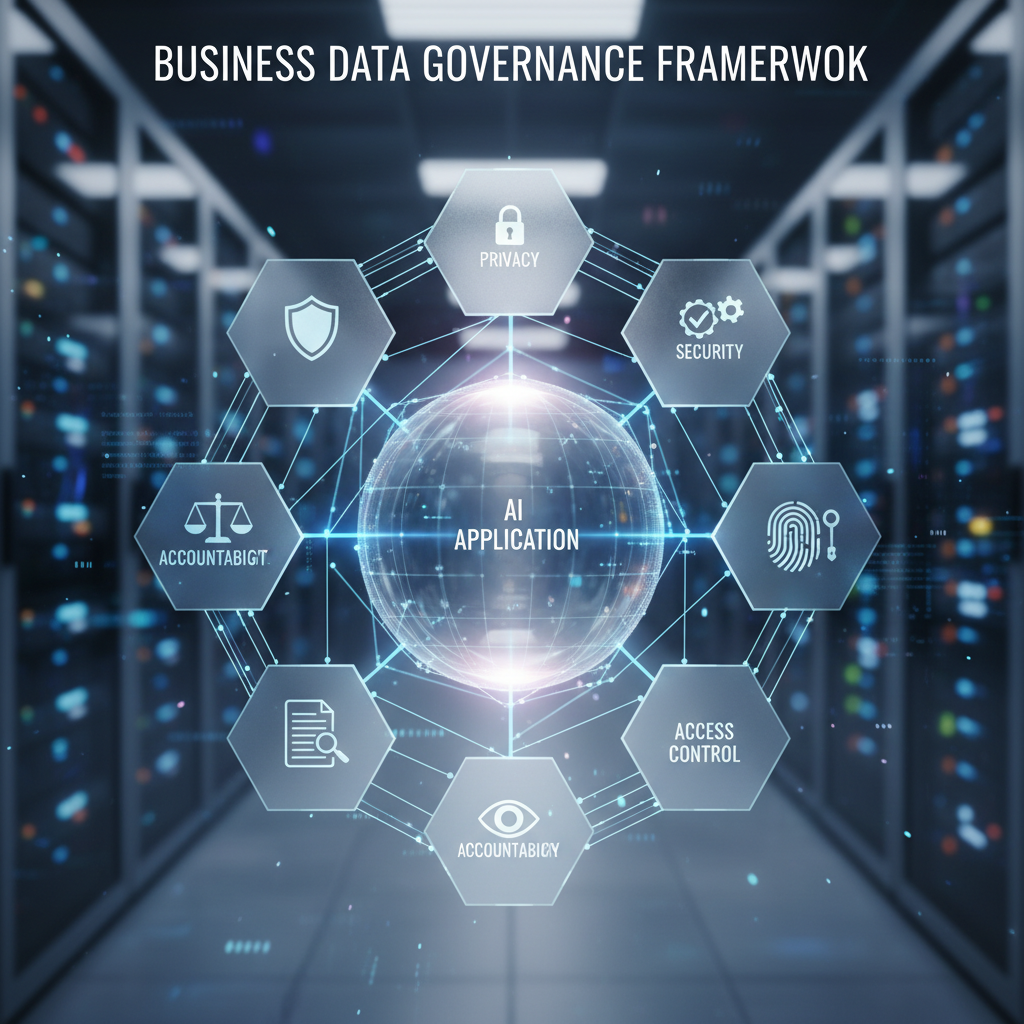
AI Data Governance: Protect Data While Adopting AI
Artificial intelligence can help businesses search documents, summarize information, automate routine tasks, and support faster decisions. However, intelligent applications often depend on large amounts of data, including confidential, personal, or commercially sensitive information. AI data governance gives organizations a structured way to manage that information while controlling privacy, security, quality, access, and accountability risks.
Effective governance is not about preventing AI adoption. It is about creating clear boundaries for how data may be collected, prepared, shared, used, monitored, and deleted. When governance is built into an AI initiative from the beginning, teams can explore useful applications without treating information protection as an afterthought.
What Is AI Data Governance?
AI data governance is the collection of policies, responsibilities, processes, and technical controls used to manage data throughout an AI system’s lifecycle. It covers both the information used to build or configure an application and the data processed after the application is deployed.

This includes training data, user prompts, uploaded files, generated responses, system logs, feedback, and information shared with outside service providers. Governance should also address who is responsible for the data, who may access it, how long it is retained, and how problems are reported and corrected.

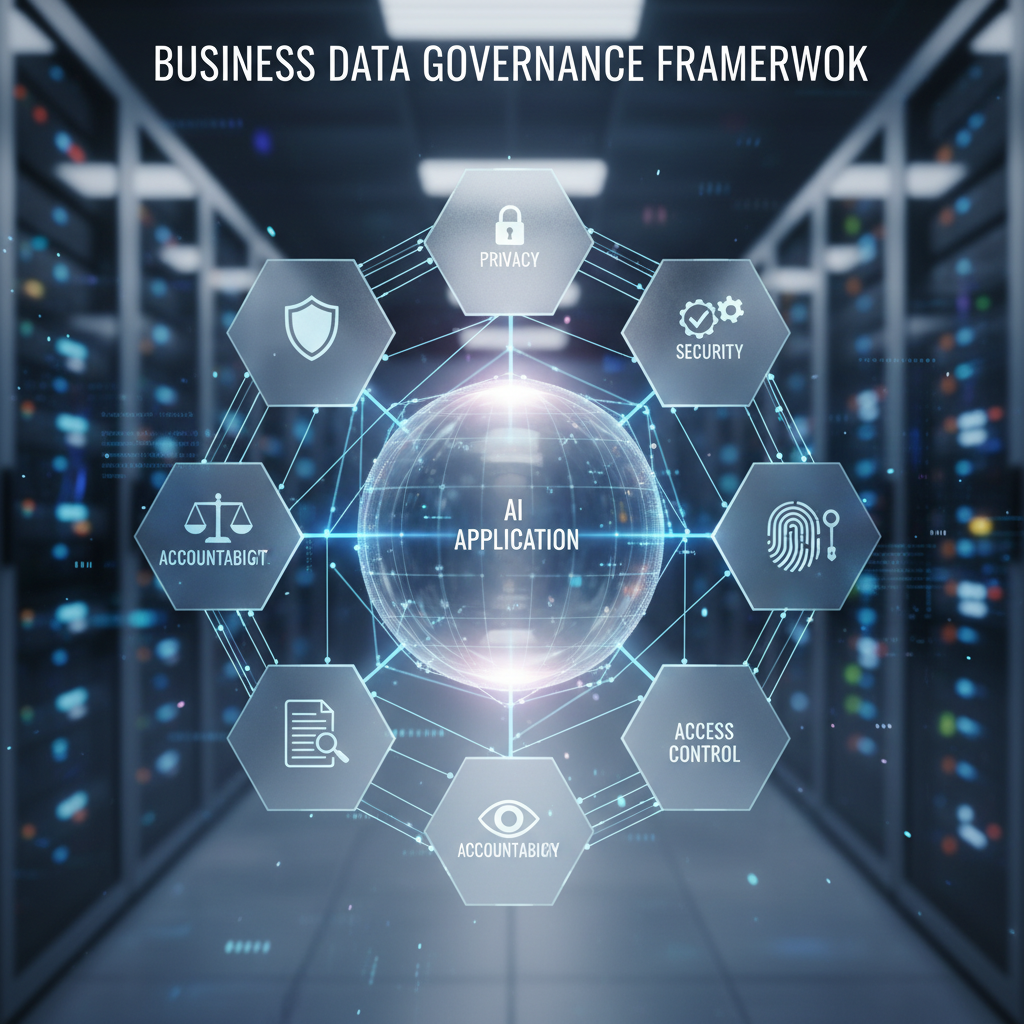
Start With a Clear Data Inventory
A business cannot protect information it does not understand. Before approving an AI application, identify the types of data the system will receive, generate, store, or transmit. Document where that information comes from, where it moves, and which teams or third parties can access it.
A practical inventory can classify data into categories such as:
- Public information approved for general use
- Internal operational data
- Confidential business information
- Personal or sensitive information
- Restricted records requiring additional controls
Classification helps teams decide which uses are acceptable. For example, public product documentation may be suitable for a general-purpose assistant, while employee records or confidential negotiations may require a controlled environment or may need to be excluded entirely.
Build Privacy Into AI Workflows
Privacy controls should begin with data minimization. An AI system should receive only the information needed for its defined purpose. Collecting extra data because it might become useful later creates unnecessary exposure and makes retention harder to manage.
Teams should review whether personal identifiers can be removed, masked, or replaced before information enters an AI workflow. They should also establish retention periods for prompts, files, outputs, and logs. Users need clear instructions explaining what they may enter and which information is prohibited.
Privacy reviews should consider the full workflow rather than only the model. Connected databases, browser extensions, plug-ins, exports, and analytics tools can introduce additional paths through which information may be stored or disclosed.
Strengthen Security and Access Control
AI applications should follow the same core security principles applied to other important business systems. Access should be based on job responsibilities rather than convenience. Employees should receive only the permissions required for their work, and those permissions should be reviewed when roles change.
Practical Security Measures
- Require strong authentication for users and administrators.
- Separate development, testing, and production environments.
- Encrypt sensitive data during transfer and storage where appropriate.
- Record important administrative actions and access events.
- Remove access promptly when employees or contractors leave.
- Test how the application handles malicious prompts, unsafe files, and unintended disclosures.
- Maintain a response process for suspected security or privacy incidents.
Logging can support investigations and accountability, but logs may contain sensitive content. They should therefore have their own access restrictions, retention rules, and monitoring controls.
Protect Data Quality and Context
AI output quality depends partly on the information supplied to the system. Incomplete, outdated, duplicated, or poorly labeled data can produce misleading results. Governance should define who owns important datasets and who is responsible for reviewing changes.
Useful data quality checks include confirming accuracy, identifying missing fields, tracking the origin of records, managing duplicates, and recording when information was last reviewed. Teams should also document the intended meaning and limitations of a dataset. Without context, even accurate information can be used incorrectly.
Hypothetical example: A company creates an internal AI assistant to answer questions about workplace procedures. If the assistant retrieves both current and retired policy documents, it may present outdated guidance. A governance process could require document owners to approve source material, archive superseded versions, and display the date of the policy used in each response.
Make AI Use Transparent and Accountable
Employees should know when they are interacting with an AI system and understand its intended purpose. They should also be told that generated content may contain mistakes and may require verification.
Accountability becomes clearer when each system has named owners. A business may assign responsibility for technical operation, data stewardship, security, privacy review, user support, and business approval. These roles can be held by different people, but responsibilities should not be left ambiguous.
Documentation should explain what the application does, which data it uses, its known limitations, and the situations in which people must review its output. This information does not need to reveal protected technical details. Its purpose is to help users make informed decisions and give reviewers a reliable record of how the system is governed.
Keep Humans Involved in Important Decisions
Human oversight is essential when AI output could significantly affect employees, customers, finances, safety, or business operations. Reviewers should have enough knowledge, authority, and time to question the system rather than simply approve its recommendation.
Businesses can define escalation points for low-confidence results, conflicting information, unusual cases, or sensitive decisions. They should also provide a way for users to report inaccurate, biased, unsafe, or inappropriate output.
Automation may improve efficiency, but it should not remove meaningful review where context and judgment matter. The level of oversight should reflect the potential impact of an error.
Evaluate Third-Party AI Risks
External providers can simplify implementation, but they also affect how business data is handled. Before adopting any third-party platform, review its data practices, security controls, retention options, access model, incident procedures, and use of subcontractors.
Questions for vendors should include:
- What information is collected from users?
- Where is customer data stored and processed?
- Is submitted content used to train or improve shared models?
- Can retention be limited or disabled?
- How can customer data be exported or deleted?
- Which personnel and subcontractors may access the information?
- How are security incidents communicated?
- What happens to data when the service ends?
The same review principles apply whether a business is considering a widely used AI service, a specialized provider, or a platform such as ZAMZILLA. The name of the tool should not replace a documented assessment based on the organization’s data, intended use, and risk tolerance.
Create a Practical Governance Program
AI data governance works best as an ongoing business process. Start with a manageable framework and improve it as applications and risks change.
- Define acceptable uses. State which AI activities are permitted, restricted, or prohibited.
- Assign ownership. Identify accountable business, data, security, and technical roles.
- Classify information. Connect data categories to clear handling requirements.
- Review applications before deployment. Examine data flows, access, providers, limitations, and oversight needs.
- Train users. Provide practical examples of safe prompting, verification, and incident reporting.
- Monitor performance. Review access logs, user feedback, output quality, and unexpected behavior.
- Reassess regularly. Update controls when data sources, vendors, integrations, or business purposes change.
Conclusion
Businesses do not have to choose between protecting information and using intelligent applications. A thoughtful AI data governance program connects innovation with privacy, security, data quality, controlled access, transparency, accountability, and human oversight. By understanding data flows, defining responsibilities, reviewing third parties, and monitoring systems after launch, organizations can adopt AI more carefully and make better-informed decisions about where it belongs.
Frequently Asked Questions
Who should be responsible for AI data governance?
Responsibility should be shared across business leadership, data owners, security teams, privacy specialists, technical teams, and users. Each AI application should also have a clearly named owner who coordinates decisions and follow-up actions.
Should employees enter confidential information into AI tools?
Only when the organization has approved the tool and the specific use, and when appropriate protections are in place. Employee guidance should clearly identify prohibited information and approved alternatives.
How often should an AI application be reviewed?
Reviews should occur before deployment and whenever the system’s purpose, data sources, integrations, provider terms, or risk profile changes. Ongoing monitoring can help identify issues between formal reviews.
Can AI output be treated as automatically accurate?
No. AI-generated content can be incomplete, incorrect, or lacking context. Important outputs should be checked against reliable information and reviewed by a qualified person when the consequences of an error are significant.