
Intelligent Copilots vs. Traditional Software: Enterprise Guide for 2026
Intelligent Copilots vs. Traditional Software: What Enterprises Need to Know in 2026
Enterprises in 2026 are facing a clear technology shift. For years, traditional software helped teams store data, automate repeatable tasks, and standardize workflows. That model still matters. But a new category is changing how work gets done: intelligent copilots.
The difference is not just about better interfaces or smarter search. It is about a fundamental change in how software supports people. Traditional software asks users to adapt to the system. Intelligent copilots adapt to the user, the task, and the context.
For enterprise leaders, understanding this distinction is essential for planning investments, improving productivity, and staying competitive.

What Traditional Software Does Well
Traditional enterprise software is built around structured processes. It is reliable, predictable, and usually designed to handle a specific function at scale.

Common strengths include:
- Clear rules and workflows
- Strong compliance controls
- Repeatable reporting
- Stable data management
- Easy measurement of outputs
Systems like ERP, CRM, HR platforms, and ticketing tools have long served as the backbone of enterprise operations. They excel when the task is well defined and the process does not change often.
However, traditional software has limits. It depends on users knowing where to click, what fields to fill in, and how to interpret the system. If the workflow changes, the software often needs configuration, training, or custom development.
That is where intelligent copilots begin to stand out.
What Makes Intelligent Copilots Different
An intelligent copilot is not just a chatbot or a search layer. It is software that can understand intent, generate recommendations, complete tasks, and support decision-making in real time.
Instead of forcing users to navigate rigid menus, copilots can:
- Answer questions in natural language
- Summarize documents and meetings
- Draft emails, reports, and proposals
- Suggest next steps based on context
- Automate multi-step workflows
- Surface insights from large data sets
In practice, this means the copilot becomes a working partner rather than just a tool. It can help employees move faster, reduce cognitive load, and make better decisions with less friction.
This is why many enterprises are moving from software that simply records work to software that actively participates in work.
The Core Difference: Automation vs. Adaptation
The biggest distinction between traditional software and intelligent copilots is how they handle complexity.
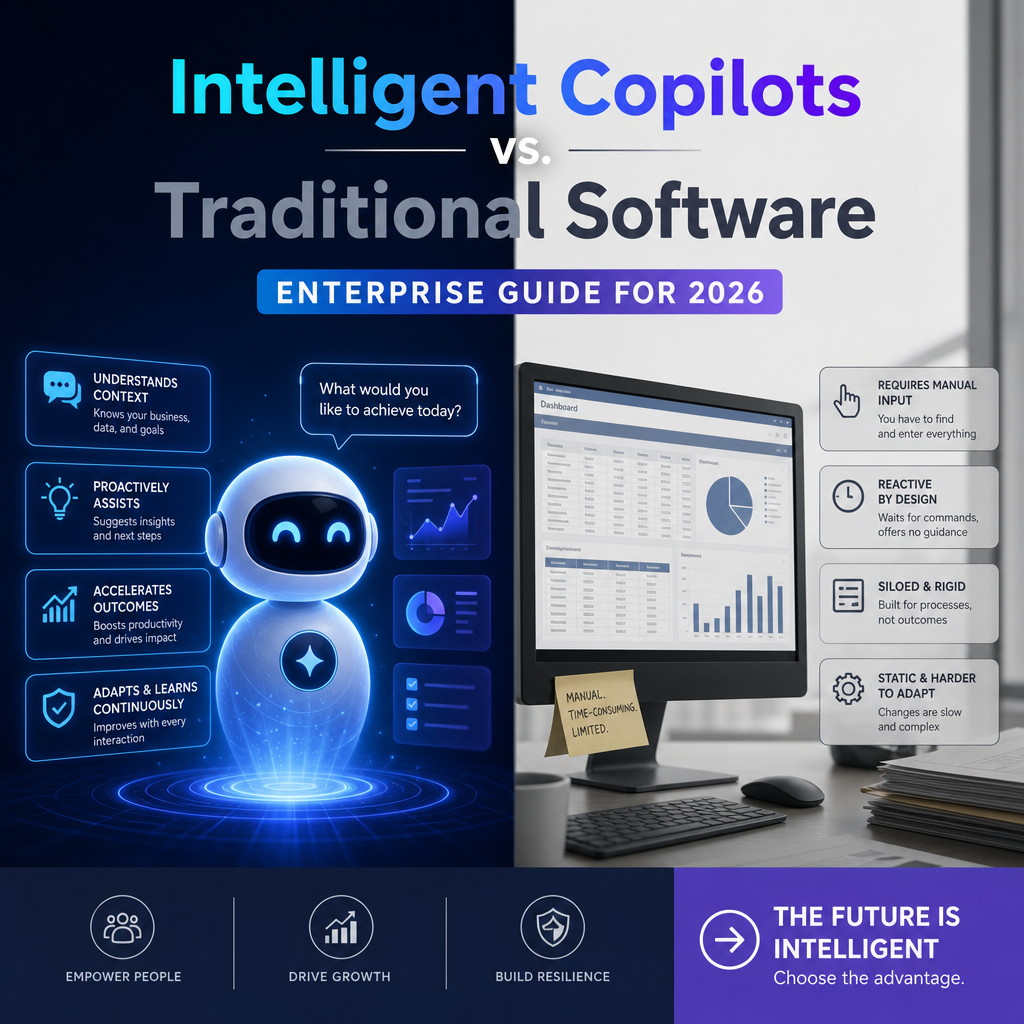
Traditional software is best at automation. It follows prebuilt rules. If a process changes, the system must be updated.
Intelligent copilots are better at adaptation. They can interpret messy inputs, handle unstructured information, and adjust to different contexts with less manual configuration.
Traditional Software:
- Requires users to follow the system
- Works best with structured tasks
- Relies on predefined logic
- Often needs IT support for changes
Intelligent Copilots:
- Respond to user intent
- Work across varied tasks
- Learn from context and patterns
- Support dynamic, fast-changing work
This does not mean copilots replace traditional software. In most enterprises, they will sit on top of existing systems and make them easier to use.
Where Enterprises See the Biggest Impact
The strongest use cases for intelligent copilots in 2026 are emerging in areas where employees spend too much time searching, summarizing, or switching between systems.
Customer Support
Copilots can draft responses, surface relevant policies, and summarize customer history in seconds. This helps agents resolve issues faster and more consistently.
Sales and Marketing
Teams can use copilots to personalize outreach, generate account summaries, analyze campaign performance, and create first drafts of content.
Finance and Operations
Copilots can assist with variance analysis, report generation, invoice review, and process exceptions, especially when data comes from multiple systems.
Human Resources
HR teams can use copilots to answer policy questions, draft communications, and support onboarding with more personalized guidance.
Software Development
Developers already use copilots to write code, explain functions, identify bugs, and speed up testing. The same pattern is expanding into broader enterprise workflows.
Risks Enterprises Must Manage
Despite the promise, intelligent copilots introduce new risks that leaders cannot ignore.
Key concerns include:
- Hallucinations or inaccurate outputs
- Data privacy and access control issues
- Overreliance on AI-generated recommendations
- Regulatory and compliance challenges
- Inconsistent performance across use cases
For enterprises, trust is everything. A copilot that is helpful but unreliable will quickly lose credibility. That is why governance, human review, and strong data policies are critical.
Organizations should also define where copilots can act independently and where they must only assist. Not every task should be automated, especially in regulated or high-stakes environments.
How to Evaluate Copilot Readiness
Before adopting intelligent copilots at scale, enterprises should ask a few practical questions:
- Which workflows are most time-consuming or repetitive?
- What data sources will the copilot need access to?
- How will outputs be reviewed and validated?
- What security and compliance standards must be met?
- How will success be measured?
A good copilot strategy starts with narrow, high-value use cases. It is better to improve one workflow significantly than to launch many poorly governed pilots.
The Enterprise Future: Human + Copilot
The future is not a choice between humans and software. It is a shift toward human and copilot collaboration.
Traditional software will continue to power core systems of record. But intelligent copilots will increasingly shape how employees interact with those systems. They will make enterprise technology more conversational, more adaptive, and more useful in everyday work.
In 2026, the winners will not be the companies that adopt the most AI for its own sake. They will be the ones that use intelligent copilots to remove friction, improve decision-making, and let people focus on higher-value work.
That is the real difference enterprises need to know.