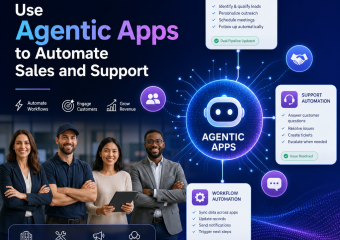

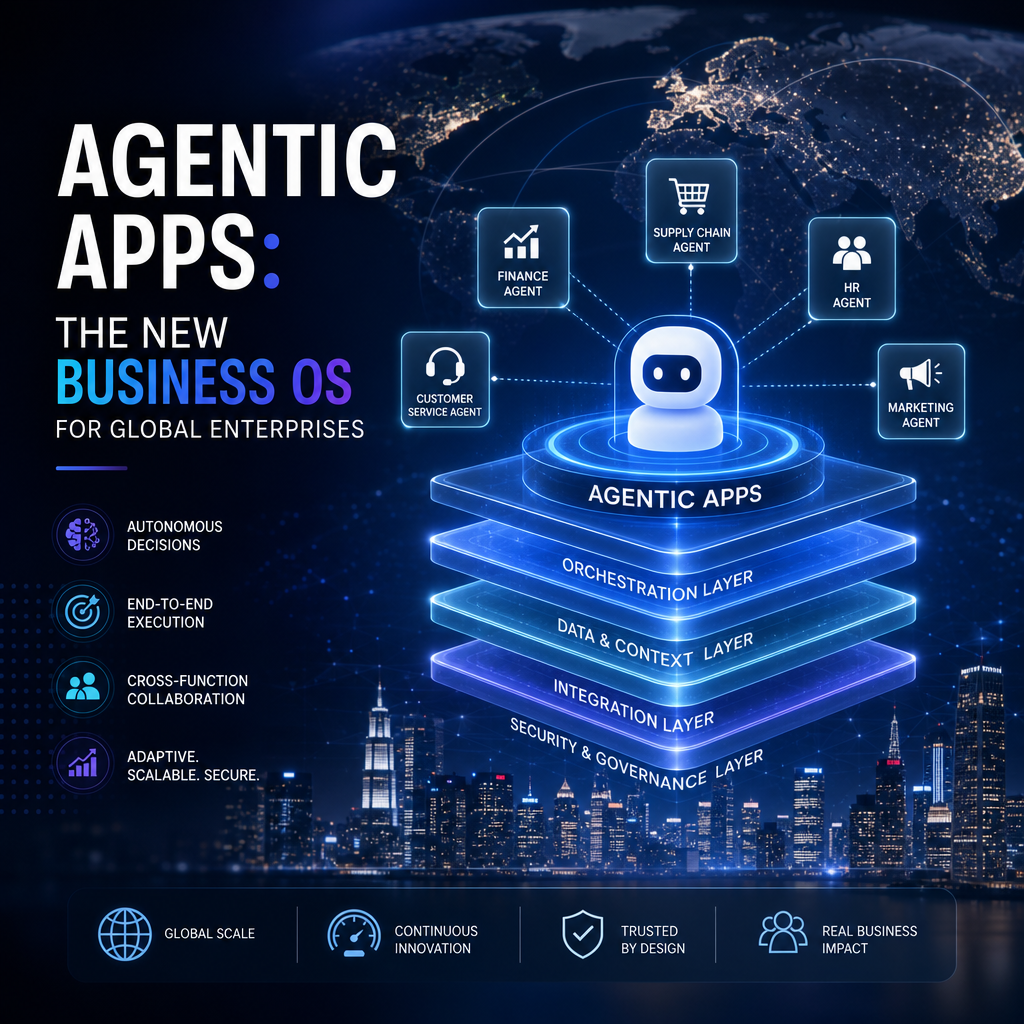
Agentic Apps: The New Business OS for Global Enterprises
From Local Services to Global Enterprises: Why Agentic Apps Are the New Business OS
Businesses do not grow in a straight line. A local service company can become a regional brand, then a national operator, and eventually a global enterprise. As that happens, the systems behind the business must evolve too.
For years, companies relied on a patchwork of tools: CRMs, spreadsheets, chat platforms, ticketing systems, email threads, and manual approvals. These tools helped teams get by, but they were never designed to act like a true operating system for the business.
That is changing. Agentic apps are emerging as the new business OS—a layer of software that does not just store information or route tasks, but can understand goals, take action, coordinate workflows, and adapt to changing conditions. For companies of every size, that shift is becoming a major competitive advantage.

What Is a Business OS?
A business operating system is the core stack that keeps a company running. It connects people, processes, and data so the business can function efficiently.

Traditional systems focus on managing work.
Agentic apps focus on moving work forward.
Instead of waiting for a human to click through every step, an agentic app can:
- interpret a request
- pull information from connected tools
- recommend or execute next steps
- learn from outcomes
- escalate only when human judgment is needed
This makes the software less like a dashboard and more like a digital operations layer.
Why Traditional Software Falls Short
Most business software was built for a world where employees manually handled most processes. That model breaks down as companies scale.
A local business might manage with:
- one inbox for customer requests
- a shared spreadsheet for scheduling
- manual invoicing
- ad hoc communication between teams
But as the company expands, these systems become slow, inconsistent, and difficult to audit. Teams spend more time coordinating than actually serving customers.
The problem is not effort. It is architecture.
Traditional software is fragmented. Agentic apps are designed to orchestrate.
How Agentic Apps Change the Game
Agentic apps bring intelligence into the flow of work. They do not just respond to commands; they work toward outcomes.
1. They reduce manual coordination
Many business delays happen because no one owns the next step. Agentic apps can identify bottlenecks and keep tasks moving automatically.
2. They improve decision-making
By connecting data across systems, agentic apps can surface recommendations in real time. That means faster responses and fewer missed opportunities.
3. They scale without proportionally scaling headcount
A growing enterprise often needs more people just to manage process overhead. Agentic apps help teams do more with the same resources.
4. They make operations more consistent
When workflows are automated and guided by intelligent agents, companies are less dependent on individual memory or habits. That consistency matters at scale.
From Local to Global: Why the Need Becomes Clear
The move from local services to global enterprises introduces complexity in every direction.
A small company may only need to manage a handful of customers and one service area. A global enterprise may need to coordinate:
- multiple regions
- different regulations
- time zones
- languages
- supply chains
- customer support channels
- internal teams across departments
At that level, software must do more than record transactions. It must act like a system of action.
Agentic apps are especially valuable here because they can adapt workflows to context. A request from one market may require a different process than the same request in another market. An agentic system can follow rules, recognize patterns, and route work accordingly.
The Human Role Still Matters
Some people worry that agentic apps will replace human teams. In reality, they are more likely to amplify them.
The best business OS does not remove people from the loop. It removes low-value friction from the loop.
Humans remain essential for:
- strategy
- creative problem-solving
- relationship building
- ethical judgment
- exception handling
Agentic apps handle repetition, monitoring, and coordination so people can focus on work that truly needs human intelligence.
What Businesses Should Look For
Not every “AI” product is an agentic app. To function as a real business OS, the platform should be able to:
- connect to existing tools and data sources
- understand business goals and workflows
- take actions across systems
- maintain auditability and control
- support human oversight
- improve over time through feedback
The goal is not simply automation. It is autonomous coordination with clear guardrails.
The Future of Work Runs on Agents
As businesses grow, complexity rises faster than most teams can manage manually. That is why agentic apps are becoming more than a trend. They are becoming infrastructure.
For local service businesses, they offer a way to operate like a much larger company without drowning in overhead. For global enterprises, they create a smarter foundation for scale, resilience, and speed.
The companies that adopt this new layer early will not just work faster. They will build businesses that are more adaptive, more efficient, and better prepared for growth.
In that sense, agentic apps are not just another software category.
They are the new business OS.