
How Service Businesses Use Agentic Apps to Automate Sales and Support
How Service Businesses Are Using Agentic Apps to Automate Sales, Scheduling, and Support
Service businesses run on speed, responsiveness, and consistency. Whether you manage a cleaning company, salon, agency, repair service, or healthcare practice, every missed call or delayed reply can mean lost revenue. That is why more companies are turning to agentic apps—software tools that can take action, make decisions within set rules, and complete tasks with little human intervention.
Unlike basic automation, agentic apps do not just follow a fixed sequence. They can understand context, respond to changing situations, and move a task forward from start to finish. For service businesses, that means fewer manual steps, faster customer response times, and a smoother experience for both staff and clients.
What Are Agentic Apps?
Agentic apps are AI-powered applications designed to act on behalf of a business user. They can interpret requests, trigger workflows, and interact with other systems to complete work. In practice, they can help with everything from answering inquiries to booking appointments and handling routine support requests.

For service companies, this is especially valuable because many daily tasks are repetitive but still require judgment. A client may ask about pricing, availability, a reschedule, or a service issue. An agentic app can handle the simple cases automatically and escalate the complex ones to a human team member.

Automating Sales Without Losing the Human Touch
Sales in service businesses often starts with a lead form, phone call, or chat message. The challenge is responding fast enough to keep the prospect engaged. Agentic apps can help by acting immediately when a new lead comes in.
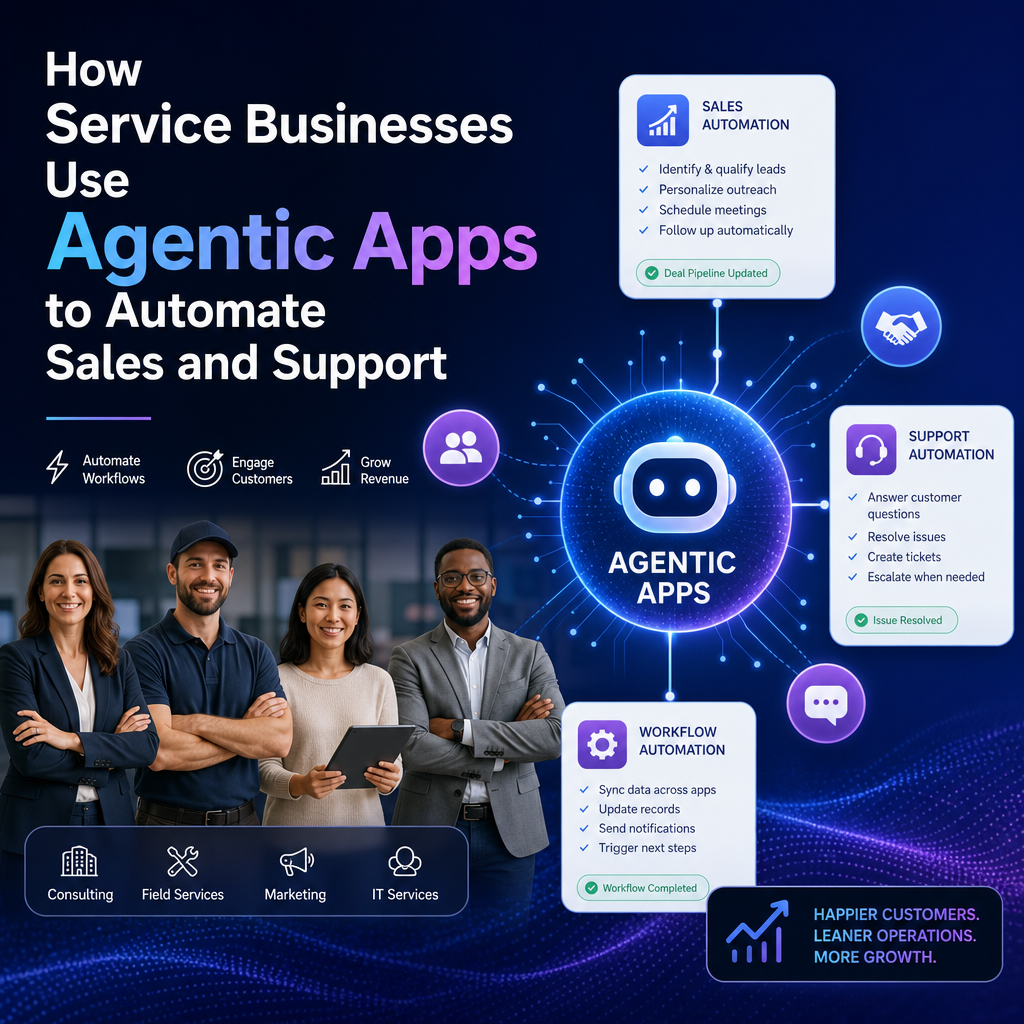
Common sales tasks agentic apps can handle
- Responding to new inquiries in real time
- Qualifying leads based on service area, budget, or need
- Recommending the right package or service tier
- Scheduling follow-up calls or demos
- Sending quotes and reminders automatically
For example, a home services company can use an agentic app to ask a few qualifying questions, confirm the customer’s location, and then suggest the correct appointment slot. A marketing agency might use one to gather project details, estimate fit, and route the lead to the right salesperson.
This speeds up the sales cycle and reduces the chance that promising leads go cold.
Making Scheduling Easier for Everyone
Scheduling is one of the biggest pain points in service businesses. It often involves back-and-forth messages, calendar checks, rescheduling, and customer reminders. Agentic apps can reduce that friction significantly.
How scheduling automation works
An agentic app can:
- Check staff availability
- Match the customer’s preferred time with open slots
- Confirm appointments automatically
- Send reminders before the visit
- Handle cancellations or rescheduling requests
This creates a much smoother experience. Customers do not have to wait for office hours or email replies. Staff members spend less time juggling calendars and more time delivering the actual service.
The result is not just convenience—it is better utilization of team time. Fewer gaps, fewer no-shows, and fewer administrative headaches can have a direct impact on revenue.
Improving Customer Support Around the Clock
Service businesses are expected to be available when customers need help, but human support teams cannot always be online 24/7. Agentic apps can fill that gap by handling common support requests at any hour.
Examples of support automation
- Answering FAQs about services, pricing, or policies
- Checking appointment status
- Handling simple billing questions
- Creating support tickets
- Escalating urgent issues to a human agent
This matters because customers often want quick answers, not necessarily a long conversation. If an app can resolve a straightforward issue in minutes, the customer feels supported and the business saves time.
For more complex problems, agentic apps can collect the right information before passing the case to a team member. That means the customer gets a faster resolution and the support agent starts with better context.
Why Service Businesses Are Adopting Agentic Apps Now
Several factors are driving adoption. First, customer expectations have changed. People now expect instant responses, easy booking, and 24/7 access to information. Second, labor costs and staffing shortages make it harder to scale manually. Third, modern AI tools are now flexible enough to be useful in real business workflows.
Agentic apps help service businesses:
- Save time on repetitive tasks
- Improve customer response speed
- Reduce missed opportunities
- Lower administrative overhead
- Deliver a more consistent client experience
They also allow small teams to operate more like larger organizations without adding as much staff.
Getting Started the Right Way
The best way to adopt agentic apps is to begin with one clear workflow. Start with a task that is repetitive, time-sensitive, and easy to measure, such as lead intake, appointment scheduling, or FAQ support.
A practical rollout approach
- Identify the most common customer requests
- Choose one workflow with clear rules
- Integrate the app with your calendar, CRM, or help desk
- Test with a small group of users
- Review performance and refine the rules
It is also important to keep human oversight in place. Agentic apps work best when they support your team rather than replace it entirely. They should handle routine work, while people focus on exceptions, relationship building, and high-value decisions.
The Future of Service Operations
As agentic apps become more capable, service businesses will likely use them across the entire customer journey. From the first inquiry to the final follow-up, these tools can reduce delays and improve service quality.
The companies that benefit most will be the ones that combine automation with a strong customer experience. In other words, the goal is not to remove the human element. It is to free people from repetitive work so they can spend more time doing what matters most.
For service businesses looking to grow efficiently, agentic apps are quickly becoming one of the most practical tools available.