
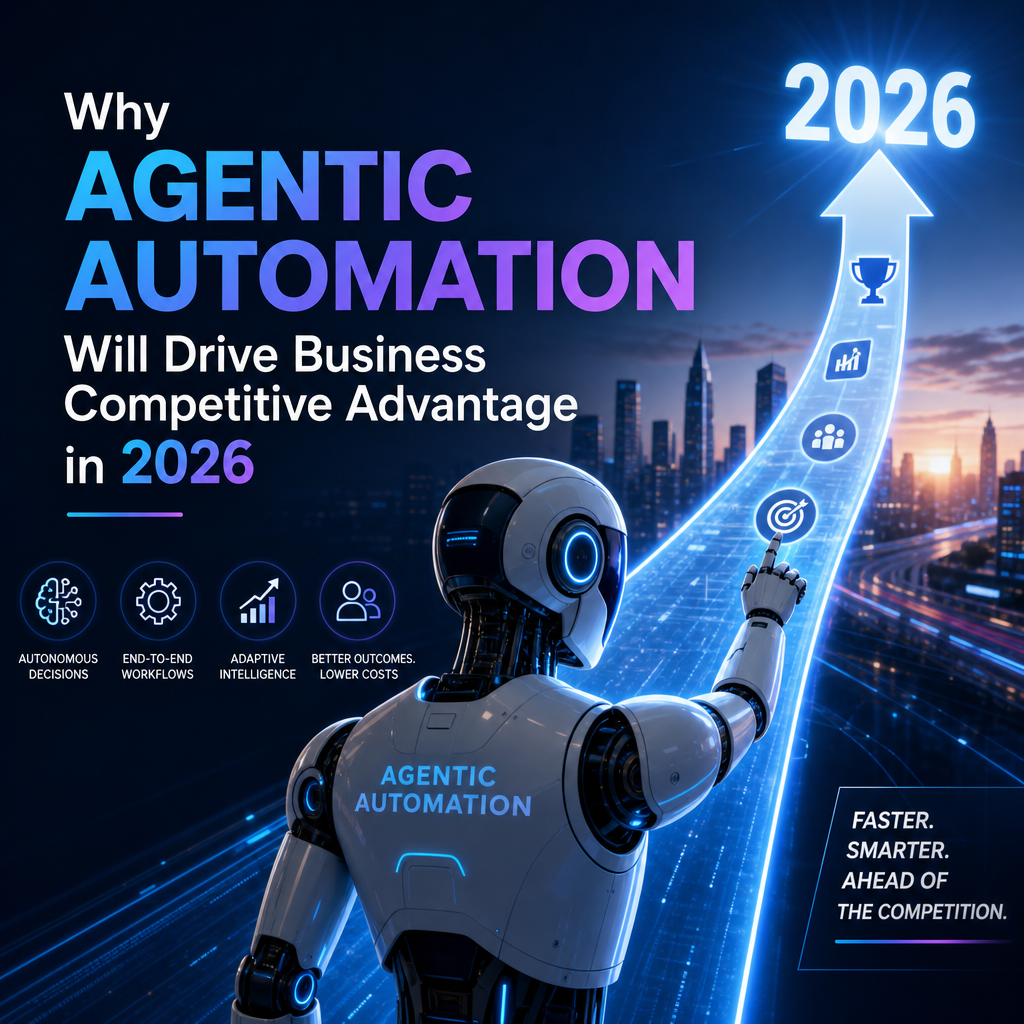
Why Agentic Automation Will Drive Business Competitive Advantage in 2026
Why Agentic Automation Is the Competitive Advantage Every Business Needs in 2026
Agentic automation is quickly becoming one of the most important business capabilities of the decade. In 2026, companies will no longer win simply by automating repetitive tasks or adding more software tools. The real advantage will come from systems that can observe, decide, act, and improve with minimal human intervention.
That is the promise of agentic automation: intelligent workflows powered by AI agents that can handle complex business processes end to end. For businesses facing pressure to move faster, reduce costs, and adapt to constant change, this is not just a technology trend. It is a competitive necessity.
What Makes Agentic Automation Different?
Traditional automation is rule-based. It follows predefined instructions and works well for predictable tasks. If the input changes or the process becomes more complex, the system usually breaks or needs manual intervention.

Agentic automation is different. It combines automation with AI-driven decision-making. Instead of only executing tasks, AI agents can:

- interpret context
- make choices based on goals
- coordinate multiple steps across systems
- learn from outcomes
- adjust actions in real time
This makes agentic automation far more flexible than conventional automation. It is especially valuable in environments where customer needs, market conditions, and internal priorities change quickly.
From Task Automation to Goal Automation
The biggest shift is moving from automating individual tasks to automating outcomes. A traditional workflow might send an invoice or route a support ticket. An agentic system can manage the entire process: identify the issue, gather data, choose the best action, trigger the next step, and escalate only when needed.
That means fewer bottlenecks, less manual oversight, and faster execution across the business.
Why 2026 Is the Turning Point
The business world in 2026 will reward speed, precision, and adaptability more than ever before. Supply chains are more complex, customers expect instant responses, and competition is increasingly global. At the same time, teams are under pressure to do more with less.
Agentic automation addresses these challenges directly.
1. It Reduces Operational Drag
Many organizations lose time to small inefficiencies that add up: repeated approvals, duplicated work, slow handoffs, and disconnected systems. Agentic automation can remove much of this friction.
AI agents can keep processes moving without waiting for humans at every step. This speeds up operations and frees employees to focus on strategic work instead of administrative overhead.
2. It Improves Decision-Making
Business decisions are only as good as the data behind them. Agentic systems can continuously gather information from multiple sources, evaluate patterns, and recommend or take action based on real-time conditions.
This is especially useful in areas like:
- customer support
- sales operations
- procurement
- finance
- compliance monitoring
Instead of reacting late, businesses can respond as situations evolve.
3. It Scales Without Adding Complexity
Hiring more people is not always the fastest or most sustainable way to scale. But expanding with more software tools can create even more complexity.
Agentic automation offers a better path. It allows businesses to scale operations without multiplying manual effort. One well-designed agentic workflow can handle growing volumes while maintaining consistency and quality.
Where Agentic Automation Creates the Most Value
Not every process should be automated in the same way. The highest value comes from workflows that are repetitive, data-heavy, and dependent on judgment.
Customer Operations
AI agents can manage service requests, classify issues, draft responses, and route cases intelligently. This improves response times and creates a smoother customer experience.
Sales and Marketing
Agentic automation can qualify leads, personalize outreach, update CRM records, and coordinate follow-up actions. Teams spend less time on admin and more time building relationships.
Finance and Administration
Invoice processing, expense review, reconciliation, and policy checks can all benefit from intelligent automation. This improves accuracy while reducing workload.
IT and Internal Operations
Agentic systems can monitor tickets, reset access, coordinate updates, and flag incidents before they become major problems. That means faster resolution and less downtime.
The Real Competitive Advantage
The true advantage of agentic automation is not just efficiency. It is adaptability.
Businesses that adopt agentic automation can move faster than competitors, respond more intelligently to market shifts, and deliver better experiences with fewer resources. They are not just automating what already exists. They are redesigning how work gets done.
In 2026, that difference will matter enormously.
Companies that continue relying only on manual processes or rigid automation will struggle to keep pace. Those that embrace agentic automation will operate with more resilience, more speed, and more intelligence.
Getting Started the Smart Way
The best approach is not to automate everything at once. Start with a few high-impact workflows where delays or errors are costly. Look for processes that are:
- repetitive
- rule-heavy but still require judgment
- spread across multiple systems
- time-sensitive
- easy to measure
Then build agentic automation gradually, with human oversight where needed. The goal is to create systems that support people, not replace thoughtful control.
Conclusion
Agentic automation is becoming the competitive advantage every business needs in 2026 because it combines efficiency, intelligence, and adaptability in one powerful model. It helps organizations move beyond simple task automation and toward true operational agility.
In a business environment where speed and flexibility define success, the companies that invest in agentic automation today will be the ones leading tomorrow.