

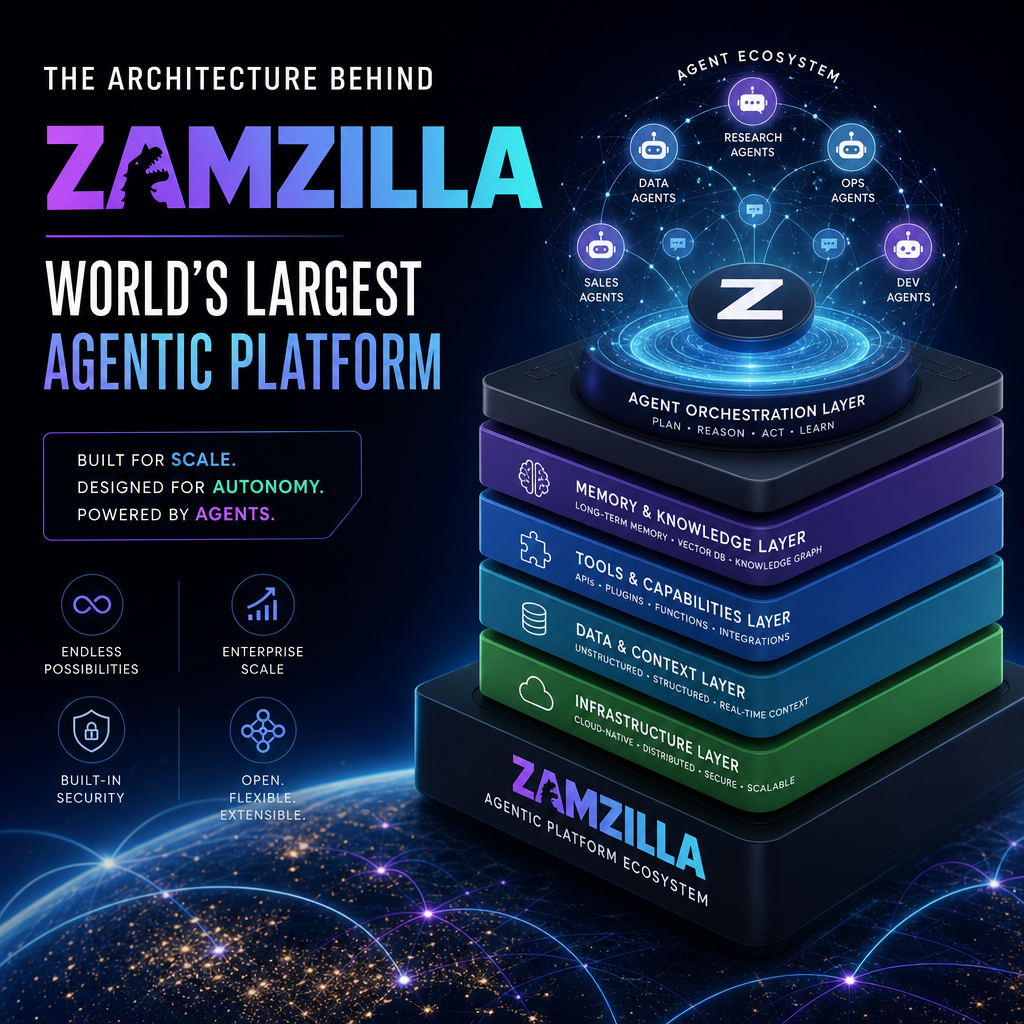
The Architecture Behind ZAMZILLA: World’s Largest Agentic Platform
The Architecture Behind ZAMZILLA: Building the World’s Largest Agentic Platform Ecosystem
The rise of AI has moved far beyond simple chatbots and single-purpose automation tools. Today, the real frontier is agentic platforms—systems that can reason, plan, execute tasks, and coordinate with other agents across complex workflows. At the center of this shift is ZAMZILLA, an ambitious ecosystem designed to support large-scale, intelligent collaboration between agents, tools, and users.
What makes ZAMZILLA stand out is not just its size, but its architecture. To build the world’s largest agentic platform ecosystem, the underlying system must be flexible, scalable, secure, and built for continuous evolution. ZAMZILLA’s architecture reflects all of these priorities.
A Modular Foundation for Scale
A platform built for autonomous agents cannot rely on a rigid monolithic design. ZAMZILLA uses a modular architecture that separates core services into independent components. This makes it easier to scale parts of the system without disrupting the whole ecosystem.

Why modularity matters
Modularity allows ZAMZILLA to:

- add new capabilities quickly
- isolate failures and reduce risk
- support different agent types and use cases
- evolve individual services independently
Each module can focus on a specific responsibility, such as orchestration, memory, permissions, task execution, or external integrations. This structure is essential when the ecosystem must support thousands of concurrent agent interactions.
The Agent Orchestration Layer
At the heart of ZAMZILLA is its orchestration layer. This is where tasks are assigned, workflows are coordinated, and decisions are routed to the right agents.
Instead of treating each agent as a standalone tool, ZAMZILLA designs them as participants in a broader network. The orchestration layer determines:
- which agent should handle a request
- how subtasks are broken down
- when human review is needed
- how results are validated before completion
This approach transforms agentic AI from a collection of isolated features into a coordinated system capable of handling complex, multi-step operations.
Memory, Context, and Continuity
One of the hardest problems in agentic systems is maintaining useful context over time. ZAMZILLA addresses this through layered memory architecture.
Types of memory in the ecosystem
- Short-term memory for active task context
- Long-term memory for persistent knowledge and preferences
- Shared memory for collaboration between agents
- Audit memory for traceability and accountability
This structure allows agents to remember what matters without being overloaded by irrelevant data. It also improves continuity, so users do not need to repeat instructions every time they interact with the system.
Secure Identity and Permission Management
A platform of this scale needs strong governance. ZAMZILLA’s architecture includes identity and permission controls that regulate what each user, agent, and tool can access.
This is especially important because agents often need to interact with sensitive systems, external APIs, or enterprise data. ZAMZILLA uses permission boundaries to ensure that every action is authorized, logged, and traceable.
Key security principles
- least-privilege access
- role-based permissions
- authenticated tool connections
- full activity logging
- policy-based action control
By embedding security into the architecture rather than adding it later, ZAMZILLA creates a safer environment for enterprise-grade deployment.
Integration-Ready by Design
No agentic ecosystem can succeed in isolation. ZAMZILLA is built to integrate with a wide range of external systems, including databases, communication platforms, business applications, and specialized AI services.
This integration-first design makes the platform highly adaptable. Agents can be extended with tools that support research, content generation, workflow automation, customer service, analytics, and more.
Common integration benefits
- faster deployment across industries
- easier workflow automation
- richer agent capabilities
- stronger interoperability with existing systems
The result is an ecosystem that fits into real-world operations instead of forcing organizations to rebuild everything from scratch.
Resilience Through Distributed Infrastructure
To support massive scale, ZAMZILLA relies on distributed infrastructure principles. Workloads can be spread across multiple services and environments, improving reliability and responsiveness.
This is critical for an ecosystem where agents may be working continuously across time zones and use cases. Distributed design helps ZAMZILLA handle spikes in demand, recover from failures, and maintain consistent performance.
Important architectural features include:
- load balancing
- service redundancy
- asynchronous task handling
- fault isolation
- horizontal scaling
Together, these make the platform more resilient and better suited for high-volume agent activity.
Designed for Human-AI Collaboration
Despite its technical sophistication, ZAMZILLA is not designed to replace people. Instead, it supports human-AI collaboration at scale. The architecture makes room for approval checkpoints, manual overrides, and collaborative workflows where humans and agents work together.
This is especially valuable in high-stakes environments such as finance, healthcare, legal services, and enterprise operations. Human oversight remains available where judgment, ethics, or compliance are essential.
The Bigger Picture
ZAMZILLA’s architecture is more than a technical blueprint. It represents a shift in how we think about AI systems: from isolated models to living ecosystems of agents, tools, memory, and governance.
By combining modularity, orchestration, secure permissions, and distributed infrastructure, ZAMZILLA creates the foundation for large-scale intelligent automation. That foundation is what makes a truly agentic platform ecosystem possible.
As agentic AI continues to evolve, architectures like ZAMZILLA’s will likely define the next generation of digital systems—systems that are not only smart, but coordinated, scalable, and ready for real-world complexity.