
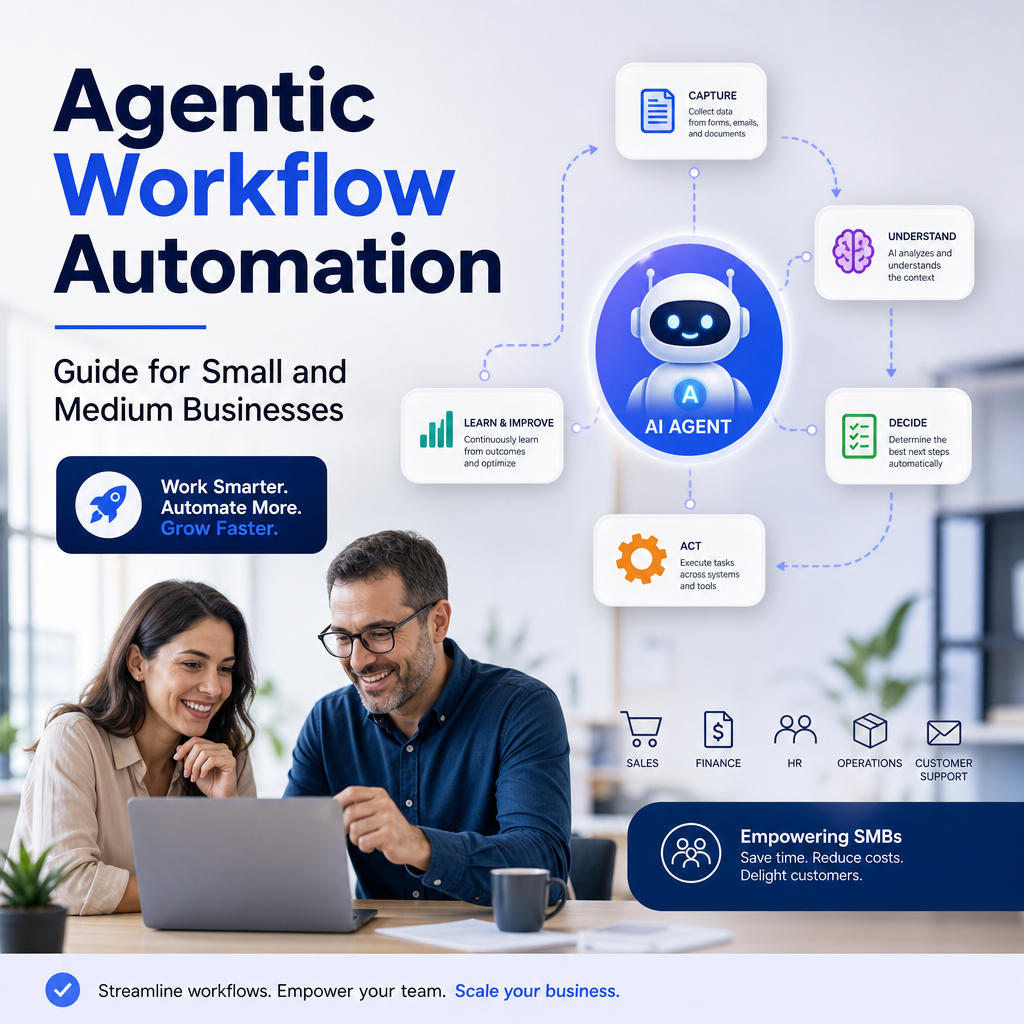
Agentic Workflow Automation Guide for Small and Medium Businesses
The Ultimate Guide to Agentic Workflow Automation for Small and Medium Businesses
Small and medium businesses are under constant pressure to do more with less. Teams are expected to respond faster, serve customers better, reduce repetitive work, and keep costs under control. That is where agentic workflow automation comes in.
Unlike traditional automation, which follows rigid rules, agentic systems can think through a task, make decisions, and adapt to changing conditions within defined limits. For SMBs, this can be a major advantage. It helps small teams operate with the speed and consistency of a much larger organization.
What Is Agentic Workflow Automation?
Agentic workflow automation is a type of automation where AI agents handle multi-step tasks with a degree of autonomy. Instead of simply moving data from one app to another, the system can interpret context, choose next steps, and complete actions based on goals.

For example, a traditional workflow might automatically send an email when a form is submitted. An agentic workflow could:

- Read the form response
- Classify the request
- Check the customer’s history
- Draft a personalized reply
- Route the case to the right team if needed
This makes agentic workflow automation especially useful for SMBs that want smarter processes without building large operations teams.
Why It Matters for Small and Medium Businesses
Many SMBs struggle with limited time, budget, and staff. Employees often wear multiple hats, which increases the chance of delays and errors. Agentic workflow automation can relieve that pressure by taking over repetitive, time-consuming tasks.
Key benefits include:
- Higher productivity: Teams spend less time on manual work
- Faster response times: Customers and internal teams get quicker results
- Improved accuracy: AI can follow consistent logic and reduce human error
- Scalability: Processes can grow with the business
- Better employee focus: Staff can concentrate on strategy, sales, and customer relationships
For SMBs, the goal is not to replace people. It is to support them with intelligent systems that make everyday work easier.
Common Use Cases for SMBs
Agentic workflow automation can be applied across many departments. The best use cases are usually the ones with repetitive decisions, predictable steps, or high volumes of requests.
1. Customer support
AI agents can sort incoming tickets, answer common questions, suggest responses, and escalate complex issues. This reduces support bottlenecks and improves service quality.
2. Sales operations
Agents can qualify leads, update CRM records, schedule follow-ups, and generate summaries from calls or emails. Sales teams save time and respond more quickly to opportunities.
3. Marketing workflows
Agentic systems can help draft content, monitor campaign performance, segment audiences, and recommend next actions based on engagement data.
4. Finance and administration
SMBs can automate invoice processing, expense categorization, payment reminders, and document routing. This helps reduce paperwork and keeps operations organized.
5. Human resources
From onboarding new hires to answering employee policy questions, AI agents can streamline HR processes and reduce administrative workload.
How It Differs from Traditional Automation
Traditional automation works best when the process is stable and the rules are clear. If-then workflows are reliable, but they can be inflexible.
Agentic workflow automation goes further. It can handle variation, interpret instructions, and decide what to do next. That makes it ideal for tasks that are too complex for simple automation but still repetitive enough to delegate.
Traditional automation:
- Follows fixed rules
- Works well for simple tasks
- Breaks when conditions change
Agentic workflow automation:
- Understands context
- Adapts to changing inputs
- Completes multi-step tasks with less manual intervention
For SMBs, this flexibility can unlock automation opportunities that were previously too difficult to manage.
How to Get Started
Adopting agentic workflow automation does not have to be overwhelming. A phased approach works best.
Step 1: Identify repetitive work
Look for tasks that are time-consuming, rule-based, and frequent. Common examples include email triage, customer follow-ups, document handling, and report generation.
Step 2: Choose a clear business goal
Start with a specific outcome, such as reducing response time, saving staff hours, or improving lead qualification. Clear goals make it easier to measure success.
Step 3: Map the workflow
Document each step, including inputs, decisions, approvals, and outputs. This helps define where an AI agent can operate safely and effectively.
Step 4: Start small
Pilot one workflow before expanding. A limited use case reduces risk and makes it easier to refine prompts, rules, and integrations.
Step 5: Add human oversight
Even smart systems need supervision. Keep humans involved for approvals, exceptions, and sensitive decisions.
Best Practices for SMB Success
To get the most value from agentic workflow automation, SMBs should follow a few simple principles.
- Keep workflows focused: Start with one process at a time
- Set boundaries: Define what the agent can and cannot do
- Use quality data: Better inputs lead to better outcomes
- Monitor performance: Track speed, accuracy, and user satisfaction
- Review regularly: Improve workflows based on real results
The most successful SMBs treat automation as an evolving system, not a one-time setup.
The Future of SMB Operations
As AI tools become more capable, agentic workflow automation will likely become a standard part of business operations. SMBs that adopt it early can gain a meaningful edge by improving efficiency, responsiveness, and agility.
The real opportunity is not just saving time. It is building a business that can adapt faster, serve better, and scale smarter.
For small and medium businesses, that can make all the difference.